The Drilling Principle of the Dual Servo Spindle: Precision Redefined

page views :
release time : 2026-04-27

    At the heart of modern high-precision machining lies a critical component: the spindle. While traditional CNC spindle units have driven manufacturing for decades, a new generation of technology is setting a higher standard. The dual servo spindle, exemplified by advanced models like the YSA spindle, represents a fundamental leap in how drilling operations are conceived and executed. This article explores the innovative working principle behind this technology and its transformative impact.

Beyond Rotation: The Core Concept of Dual Servo Control

    A conventional drilling spindle is primarily a single-axis system. Its main—and often only—function is to rotate the cutting tool at a controlled speed. The linear feed motion, which drives the tool into the material, is typically provided by an external axis of the CNC machine (like the Z-axis). While functional, this separation of rotation and feed control can lead to compromises in synchronization, especially during demanding operations like deep-hole drilling or when exiting the material.

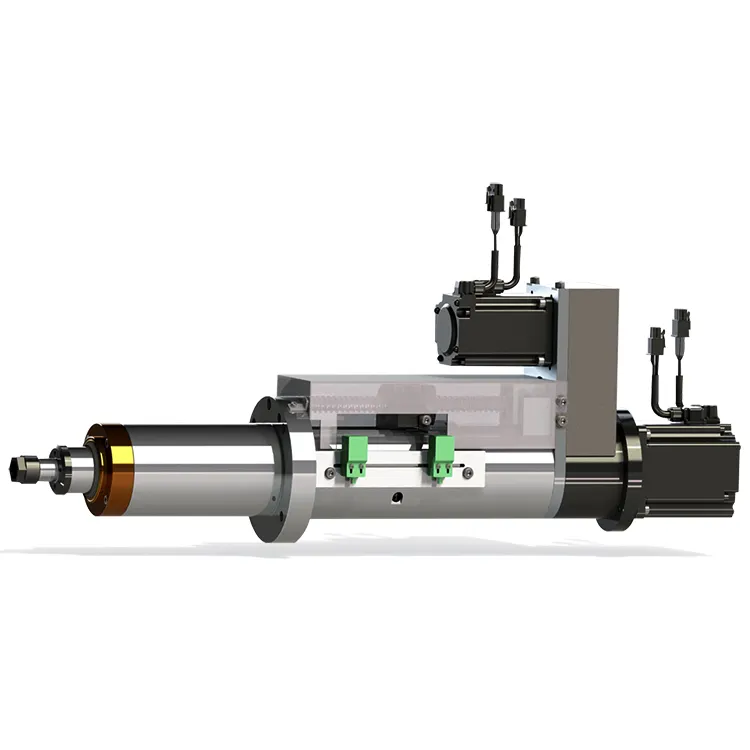
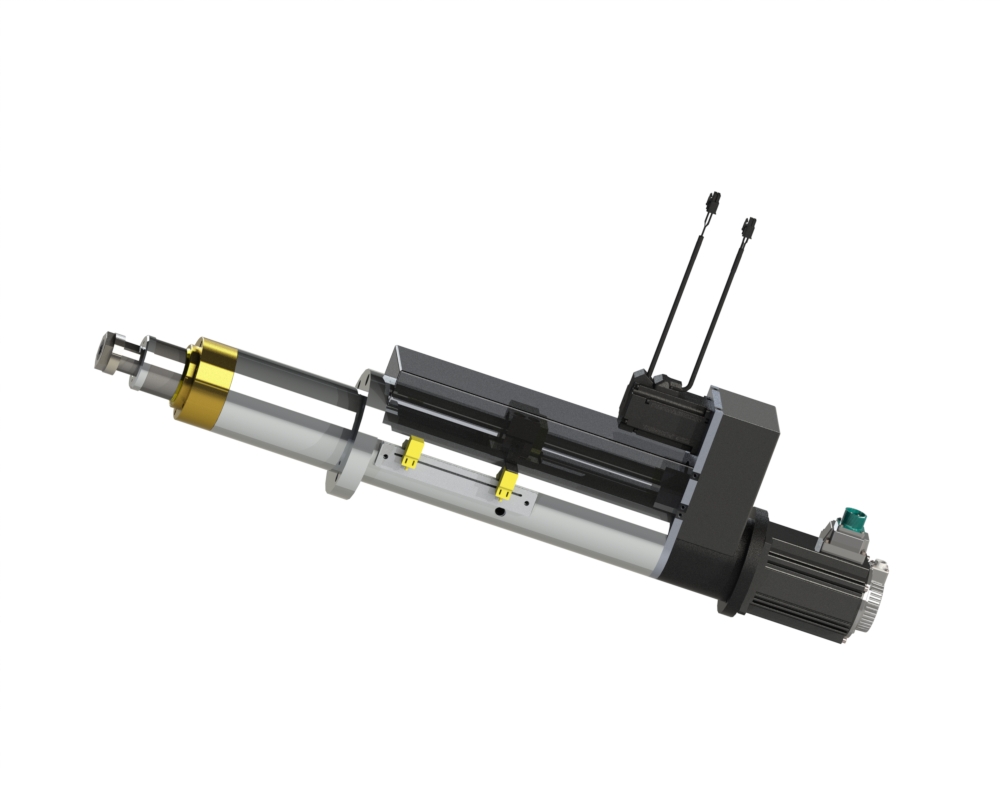
The dual servo spindle dismantles this traditional separation. Its defining principle is the integration of two independent, digitally controlled servo motors within a single compact unit:

  1. The Main Spindle Servo Motor: This motor controls the rotation (RPM) of the tool, just like a traditional spindle.


  2. The Feed (Z-axis) Servo Motor: This dedicated motor controls the precise linear in-and-out movement (feed rate) of the entire spindle quill.


This architecture gives the dual servo spindle its own autonomous, programmable Z-axis, making it a self-contained drilling and tapping cell.

The Drilling Workflow: A Synchronized Dance

The drilling process with a dual servo spindle is a masterclass in synchronized motion control. Here’s a step-by-step look at its working principle:

  1. Approach: The CNC machine positions the dual servo spindle at the X-Y coordinates of the hole. The feed servo retracts the quill, holding the rotating tool at a safe clearance height.


  2. Precision Engagement: Upon command, the feed servo motor initiates the linear advance. The key differentiator is the absolute synchronization between the programmable feed rate (mm/rev) and the spindle speed (RPM). The two internal servo drives communicate continuously, ensuring the tool advances exactly the right distance per revolution, regardless of minor load variations.


  3. Controlled Penetration & Chip Evacuation: Throughout the cut, the system maintains this perfect electronic coupling. For optimal chip breaking and evacuation in deep-hole drilling, the YSA spindle type can be programmed for sophisticated "pecking" cycles. Here, the feed servo automatically retracts the tool at precise intervals without losing position synchronization, clearing chips before re-engaging with identical precision.


  4. Exit and Retract: Upon reaching the programmed depth, the feed servo can execute a swift, controlled retraction. Because the linear motion is independent of the machine's main axes, this action is extremely fast, significantly reducing non-cutting time. The spindle then moves to the next hole location, ready to repeat the cycle.


Key Advantages Over Conventional Spindles

The integrated dual-servo principle unlocks significant benefits:

  • Ultra-Precise Feed Control: Eliminates the mechanical backlash and compliance often found in long machine-tool axis chains, resulting in superior hole straightness, size accuracy, and surface finish.


  • Optimal Chip Management: Programmable, spindle-synchronized pecking cycles drastically improve chip control in difficult materials or deep holes, protecting the tool and the workpiece.


  • Dramatic Time Savings: The rapid, short-stroke movements of the independent feed axis are much quicker than moving the entire machine Z-axis, slashing cycle times, especially on multi-hole patterns.


  • True Tapping Capability: This is where the principle shines brightest. The two servos can operate in a rigid synchronous "rigid tapping" mode or a reversible "tension-compression" mode, allowing for perfect thread cutting without a floating holder, minimizing tap breakage.


  • Reduced Machine Wear: By offloading the repetitive feed motion from the main CNC machine's Z-axis ball screw, it reduces wear on that critical and expensive component, lowering long-term maintenance costs.


Application in Modern Manufacturing

The dual servo spindle is not just an incremental improvement; it's an enabling technology for flexible, high-mix production. It is ideally suited for:

  • High-Precision Component Manufacturing: Drilling valve bodies, fuel injectors, or hydraulic manifolds where hole quality is critical.


  • High-Efficiency Production Lines: Used in transfer lines or special machines for engine blocks, cylinder heads, or gearboxes where speed and reliability are paramount.


  • Flexible CNC Machining Centers: Mounted on a standard CNC spindle turret or as a standalone unit, it adds high-speed drilling and tapping capability without sacrificing the machine's primary milling functions.


In conclusion, the working principle of the dual servo spindle—integrating independent, intelligent control over both rotation and feed—moves precision drilling from a function of the machine tool to a function of the spindle itself. This shift, embodied by advanced designs like the YSA spindle, provides manufacturers with unprecedented control, speed, and quality, redefining what is possible in automated drilling operations.

related news
View more >>
How to Choose a Suitable Cutting Motor: A Complete Buying Gu How to Choose a Suitable Cutting Motor: A Complete Buying Gu
05 .12.2026
Wondering how to choose a suitable cutting motor? This guide introduces YSA cutting motor, cutting spindle, saw blade motor and motor for clamping saw blades, helping you select durable industrial cut...
Dual Servo Spindle: Premium Machining Solution for Motorcycl Dual Servo Spindle: Premium Machining Solution for Motorcycl
05 .08.2026
Discover how dual servo spindles improve precision and efficiency for motorcycle carburetor machining. Learn benefits, application scenarios & advantages for aluminum carburetor mass production.
How to Select the Right Dual Servo Drilling spindle for Prec How to Select the Right Dual Servo Drilling spindle for Prec
05 .04.2026
Looking for the right dual servo drilling power head for precision small hole drilling? This guide shares key selection tips on dual servo control performance, spindle speed, structural rigidity, posi...
The Drilling Principle of the Dual Servo Spindle: Precision The Drilling Principle of the Dual Servo Spindle: Precision
04 .27.2026
At the heart of modern high-precision machining lies a critical component: the spindle. While traditional CNC spindle units have driven manufacturing for decades, a new generation of technology is set...
We use cookie to improve your online experience. By continuing to browse this website, you agree to our use of cookie.

Cookies

Please read our Terms and Conditions and this Policy before accessing or using our Services. If you cannot agree with this Policy or the Terms and Conditions, please do not access or use our Services. If you are located in a jurisdiction outside the European Economic Area, by using our Services, you accept the Terms and Conditions and accept our privacy practices described in this Policy.
We may modify this Policy at any time, without prior notice, and changes may apply to any Personal Information we already hold about you, as well as any new Personal Information collected after the Policy is modified. If we make changes, we will notify you by revising the date at the top of this Policy. We will provide you with advanced notice if we make any material changes to how we collect, use or disclose your Personal Information that impact your rights under this Policy. If you are located in a jurisdiction other than the European Economic Area, the United Kingdom or Switzerland (collectively “European Countries”), your continued access or use of our Services after receiving the notice of changes, constitutes your acknowledgement that you accept the updated Policy. In addition, we may provide you with real time disclosures or additional information about the Personal Information handling practices of specific parts of our Services. Such notices may supplement this Policy or provide you with additional choices about how we process your Personal Information.


Cookies

Cookies are small text files stored on your device when you access most Websites on the internet or open certain emails. Among other things, Cookies allow a Website to recognize your device and remember if you've been to the Website before. Examples of information collected by Cookies include your browser type and the address of the Website from which you arrived at our Website as well as IP address and clickstream behavior (that is the pages you view and the links you click).We use the term cookie to refer to Cookies and technologies that perform a similar function to Cookies (e.g., tags, pixels, web beacons, etc.). Cookies can be read by the originating Website on each subsequent visit and by any other Website that recognizes the cookie. The Website uses Cookies in order to make the Website easier to use, to support a better user experience, including the provision of information and functionality to you, as well as to provide us with information about how the Website is used so that we can make sure it is as up to date, relevant, and error free as we can. Cookies on the Website We use Cookies to personalize your experience when you visit the Site, uniquely identify your computer for security purposes, and enable us and our third-party service providers to serve ads on our behalf across the internet.

We classify Cookies in the following categories:
 ●  Strictly Necessary Cookies
 ●  Performance Cookies
 ●  Functional Cookies
 ●  Targeting Cookies


Cookie List
A cookie is a small piece of data (text file) that a website – when visited by a user – asks your browser to store on your device in order to remember information about you, such as your language preference or login information. Those cookies are set by us and called first-party cookies. We also use third-party cookies – which are cookies from a domain different than the domain of the website you are visiting – for our advertising and marketing efforts. More specifically, we use cookies and other tracking technologies for the following purposes:

Strictly Necessary Cookies
These cookies are necessary for the website to function and cannot be switched off in our systems. They are usually only set in response to actions made by you which amount to a request for services, such as setting your privacy preferences, logging in or filling in forms. You can set your browser to block or alert you about these cookies, but some parts of the site will not then work. These cookies do not store any personally identifiable information.

Functional Cookies
These cookies enable the website to provide enhanced functionality and personalisation. They may be set by us or by third party providers whose services we have added to our pages. If you do not allow these cookies then some or all of these services may not function properly.

Performance Cookies
These cookies allow us to count visits and traffic sources so we can measure and improve the performance of our site. They help us to know which pages are the most and least popular and see how visitors move around the site. All information these cookies collect is aggregated and therefore anonymous. If you do not allow these cookies we will not know when you have visited our site, and will not be able to monitor its performance.

Targeting Cookies
These cookies may be set through our site by our advertising partners. They may be used by those companies to build a profile of your interests and show you relevant adverts on other sites. They do not store directly personal information, but are based on uniquely identifying your browser and internet device. If you do not allow these cookies, you will experience less targeted advertising.

How To Turn Off Cookies
You can choose to restrict or block Cookies through your browser settings at any time. Please note that certain Cookies may be set as soon as you visit the Website, but you can remove them using your browser settings. However, please be aware that restricting or blocking Cookies set on the Website may impact the functionality or performance of the Website or prevent you from using certain services provided through the Website. It will also affect our ability to update the Website to cater for user preferences and improve performance. Cookies within Mobile Applications

We only use Strictly Necessary Cookies on our mobile applications. These Cookies are critical to the functionality of our applications, so if you block or delete these Cookies you may not be able to use the application. These Cookies are not shared with any other application on your mobile device. We never use the Cookies from the mobile application to store personal information about you.

If you have questions or concerns regarding any information in this Privacy Policy, please contact us by email at . You can also contact us via our customer service at our Site.


Product Inquiry