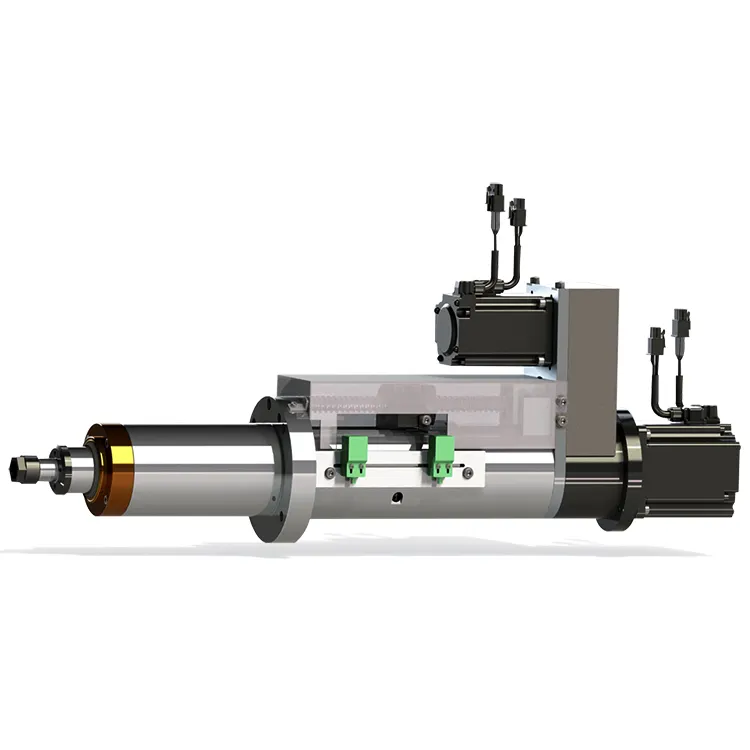
Wie man die Schleifgeschwindigkeit der Elektrospindel im Schleifprozess wissenschaftlich bestimmt

Seitenaufrufe :
Freigabezeit : 2026-04-10

Im Bereich der modernen Präzisionsfertigung ist die Elektrospindel die zentrale Antriebseinheit des Schleifprozesses, und ihre Leistung bestimmt direkt die Bearbeitungseffizienz und die Oberflächenqualität des Werkstücks. Dabei ist die Einstellung der Schleifgeschwindigkeit der Schlüssel zum Erfolg oder Misserfolg des Prozesses. Es handelt sich nicht um einen festen Wert, sondern um eine Systemtechnik, die nach mehrdimensionalen Faktoren wissenschaftlich berechnet und angepasst werden muss.

Die Kernlogik zur Bestimmung der Schleifgeschwindigkeit

Die Bestimmung der Schleifgeschwindigkeit folgt in erster Linie dem Dreifach-Anpassungsprinzip "Werkstück-Schleifscheibe-Spindel". Das spezifische Verfahren ist wie folgt:

  1. Analyse der Werkstückanforderungen
    : Dies ist der Ausgangspunkt. Es ist notwendig, die Materialeigenschaften des zu bearbeitenden Werkstücks (wie den Härteunterschied von Edelstahl, Aluminiumlegierung, Kunststoff), die Größe und die letztendlich erforderliche Oberflächenrauhigkeit zu klären. Zum Beispiel erfordert das Schleifen von Hartmetall ein hohes Drehmoment, um den Materialwiderstand zu überwinden, während die Bearbeitung von optischem Glas eine hohe Geschwindigkeit und sehr geringe Vibrationen erfordert.

  2. Wählen Sie die passende Schleifscheibe
    Die Art der Schleifscheibe (z. B. Korund, CBN, Diamant) wird entsprechend dem Werkstückmaterial ausgewählt und ihr Außendurchmesser bestimmt. Die Schleifscheibe selbst hat eine sichere maximal zulässige lineare Geschwindigkeit, die eine unüberwindbare rote Linie darstellt.

  3. Berechnung der Spindeldrehzahl
    Dies ist ein entscheidender Schritt bei der Umsetzung von Prozessanforderungen in Anlagenparameter. Die Kernformel lautet: Spindeldrehzahl (U / min) = (Lineardrehzahl der Schleifscheibe (m / s) 60) / (Durchmesser der Schleifscheibe (m) π). Bei einer CBN-Schleifscheibe mit einer erforderlichen Lineardrehzahl von 100 m / s und einem Durchmesser von 100 mm beispielsweise beträgt die berechnete theoretische Drehzahl etwa 19108 U / min, und zu diesem Zeitpunkt ist es sinnvoller, einen Schleifmotor mit einer Nenndrehzahl von 20000 U / min zu wählen.

  4. Spindelleistung prüfen
    : Die ermittelte Drehzahl muss unter Berücksichtigung der Leistungs- und Drehmomenteigenschaften in den Nenndrehzahlbereich der gewählten Elektrospindel fallen. Das Hochleistungsschleifen erfordert eine hohe Leistung (z. B.> 15 kW), während das Hochgeschwindigkeits-Präzisionsschleifen strenge Anforderungen an das dynamische Gleichgewichtsniveau (in der Regel G0,4 oder höher) und den Radialrundlauf (≤1 μm) stellt. Gleichzeitig muss geprüft werden, ob das Kühlsystem (Wasserkühlung / Luftkühlung) den Temperaturanstieg kontrollieren kann, um die Stabilität eines langfristigen Dauerbetriebs zu gewährleisten.

Präzisionspraxis des Schleifens von Spindelköpfen durch YSA

Mit bekannten Marken

     Am Beispiel des Schleifspindelkopfes von YSA verkörpert sein Produktdesign die oben genannten Anpassungsprinzipien zutiefst. Der Präzisionsschleifmotor von YSA mit einem Gehäuse aus einer hochfesten Aluminiumlegierung und importierten Präzisionslagern sorgt für geringe Vibrationen und eine hervorragende thermische Stabilität auch bei hohen Drehzahlen (von 12.000 bis 42.000 U / min), wobei der Radialdurchlauf in einem extrem kleinen Bereich gehalten wird. Dies bildet die Hardwaregrundlage für hochpräzises Spindelschleifen. In der Praxis ist die Kopplung mit einem speziellen Frequenzumrichter und die Einstellung der Grundfrequenz auf den maximalen Frequenzwert der Motorspindel ein entscheidender Schritt, um eine präzise und stabile Drehzahlregelung zu erreichen.

Zusammenfassung

Insgesamt, 

Die Schleifgeschwindigkeit einer Elektrospindel ist ein systematischer Entscheidungsprozess, keine einfache Knopfeinstellung. Sie beginnt mit einer klaren Definition der Bearbeitungsaufgabe, geht über die Scheibenauswahl und die lineare Drehzahlberechnung und gipfelt in einer umfassenden Überprüfung von Spindeldrehzahl, Leistung, Genauigkeit und Kühlleistung. Nur durch die Wahl eines zuverlässigen Schleifmotors wie YSA und die strikte Einhaltung wissenschaftlicher Auswahl- und Parametereinstellungsverfahren kann das volle Potenzial des Spindelschleifens ausgeschöpft werden, wodurch effiziente, qualitativ hochwertige Präzisionsschleifziele erreicht werden und eine solide Grundlage für eine intelligente Fertigung geschaffen wird.
Verwandte Nachrichten
Mehr anzeigen >>
Elektrische Spindeln ermöglichen Manipulatoren das Entgraten Elektrische Spindeln ermöglichen Manipulatoren das Entgraten
04 .19.2026
In diesem Beitrag werden die wesentlichen Vorteile der Integration von Hochleistungs-Elektrospindeln in Industrieroboter für Entgratungsvorgänge untersucht. Der Schwerpunkt liegt auf der Analyse des K...
Anwendungsmerkmale der elektrischen Spindel beim Entgraten v Anwendungsmerkmale der elektrischen Spindel beim Entgraten v
04 .19.2026
In diesem Beitrag werden die Hauptvorteile der Elektrospindel beim Entgraten von Industrierobotern eingehend untersucht und ihre Eigenschaften wie hohe Geschwindigkeitsgenauigkeit, flexibles Schwimmen...
Häufige Ursachen und Gegenmaßnahmen für unterbrochene Schnei Häufige Ursachen und Gegenmaßnahmen für unterbrochene Schnei
04 .19.2026
In diesem Beitrag werden die häufigsten Gründe für die Unterbrechung des Bohrens von Werkzeugen analysiert, einschließlich Schlüsselfaktoren wie Werkzeugqualität, Spindelgenauigkeit, Kühlspanabfuhr, B...
Wie man den richtigen Bohrertyp für verschiedene Materialien Wie man den richtigen Bohrertyp für verschiedene Materialien
04 .19.2026
In diesem Beitrag wird umfassend erörtert, wie der Bohrertyp für Metall-, Nichtmetall- und Verbundwerkstoffe wissenschaftlich ausgewählt werden kann, die Eigenschaften verschiedener Materialien und de...
We use cookie to improve your online experience. By continuing to browse this website, you agree to our use of cookie.

Cookies

Please read our Terms and Conditions and this Policy before accessing or using our Services. If you cannot agree with this Policy or the Terms and Conditions, please do not access or use our Services. If you are located in a jurisdiction outside the European Economic Area, by using our Services, you accept the Terms and Conditions and accept our privacy practices described in this Policy.
We may modify this Policy at any time, without prior notice, and changes may apply to any Personal Information we already hold about you, as well as any new Personal Information collected after the Policy is modified. If we make changes, we will notify you by revising the date at the top of this Policy. We will provide you with advanced notice if we make any material changes to how we collect, use or disclose your Personal Information that impact your rights under this Policy. If you are located in a jurisdiction other than the European Economic Area, the United Kingdom or Switzerland (collectively “European Countries”), your continued access or use of our Services after receiving the notice of changes, constitutes your acknowledgement that you accept the updated Policy. In addition, we may provide you with real time disclosures or additional information about the Personal Information handling practices of specific parts of our Services. Such notices may supplement this Policy or provide you with additional choices about how we process your Personal Information.


Cookies

Cookies are small text files stored on your device when you access most Websites on the internet or open certain emails. Among other things, Cookies allow a Website to recognize your device and remember if you've been to the Website before. Examples of information collected by Cookies include your browser type and the address of the Website from which you arrived at our Website as well as IP address and clickstream behavior (that is the pages you view and the links you click).We use the term cookie to refer to Cookies and technologies that perform a similar function to Cookies (e.g., tags, pixels, web beacons, etc.). Cookies can be read by the originating Website on each subsequent visit and by any other Website that recognizes the cookie. The Website uses Cookies in order to make the Website easier to use, to support a better user experience, including the provision of information and functionality to you, as well as to provide us with information about how the Website is used so that we can make sure it is as up to date, relevant, and error free as we can. Cookies on the Website We use Cookies to personalize your experience when you visit the Site, uniquely identify your computer for security purposes, and enable us and our third-party service providers to serve ads on our behalf across the internet.

We classify Cookies in the following categories:
 ●  Strictly Necessary Cookies
 ●  Performance Cookies
 ●  Functional Cookies
 ●  Targeting Cookies


Cookie List
A cookie is a small piece of data (text file) that a website – when visited by a user – asks your browser to store on your device in order to remember information about you, such as your language preference or login information. Those cookies are set by us and called first-party cookies. We also use third-party cookies – which are cookies from a domain different than the domain of the website you are visiting – for our advertising and marketing efforts. More specifically, we use cookies and other tracking technologies for the following purposes:

Strictly Necessary Cookies
These cookies are necessary for the website to function and cannot be switched off in our systems. They are usually only set in response to actions made by you which amount to a request for services, such as setting your privacy preferences, logging in or filling in forms. You can set your browser to block or alert you about these cookies, but some parts of the site will not then work. These cookies do not store any personally identifiable information.

Functional Cookies
These cookies enable the website to provide enhanced functionality and personalisation. They may be set by us or by third party providers whose services we have added to our pages. If you do not allow these cookies then some or all of these services may not function properly.

Performance Cookies
These cookies allow us to count visits and traffic sources so we can measure and improve the performance of our site. They help us to know which pages are the most and least popular and see how visitors move around the site. All information these cookies collect is aggregated and therefore anonymous. If you do not allow these cookies we will not know when you have visited our site, and will not be able to monitor its performance.

Targeting Cookies
These cookies may be set through our site by our advertising partners. They may be used by those companies to build a profile of your interests and show you relevant adverts on other sites. They do not store directly personal information, but are based on uniquely identifying your browser and internet device. If you do not allow these cookies, you will experience less targeted advertising.

How To Turn Off Cookies
You can choose to restrict or block Cookies through your browser settings at any time. Please note that certain Cookies may be set as soon as you visit the Website, but you can remove them using your browser settings. However, please be aware that restricting or blocking Cookies set on the Website may impact the functionality or performance of the Website or prevent you from using certain services provided through the Website. It will also affect our ability to update the Website to cater for user preferences and improve performance. Cookies within Mobile Applications

We only use Strictly Necessary Cookies on our mobile applications. These Cookies are critical to the functionality of our applications, so if you block or delete these Cookies you may not be able to use the application. These Cookies are not shared with any other application on your mobile device. We never use the Cookies from the mobile application to store personal information about you.

If you have questions or concerns regarding any information in this Privacy Policy, please contact us by email at . You can also contact us via our customer service at our Site.


Produkt-Anfrage